Yash Highvoltage Ltd.
Changing
the Power Game
Understanding Transformer Bushing Retrofit Solutions
Transformer bushing retrofit solutions include upgrading or replacing outdated bushings with more contemporary, high-performing models. These solutions' main goal is to prolong the operating life of transformers by addressing common problems such insulation degradation, oil leaks, and thermal stress.
Signs Indicating the Need for Retrofitting
Transformer bushings may need to be retrofitted due to a number of symptoms. These consist of aging insulation materials, partial discharge activity, oil leaks, and excessive temperature rise. Early detection of these indicators can save expensive downtime and future problems.
Yash Highvoltage Ltd.: Leader in Retrofit Solutions
One of the top suppliers of transformer bushing retrofit solutions is Yash Highvoltage Ltd. They provide comprehensive services that are customized to match the unique demands of their clients, drawing from their years of experience and skill in the field of high-voltage engineering.
Types of Transformer Bushing Retrofit Solutions Offered by Yash Highvoltage Ltd.
Numerous retrofit options are available from Yash Highvoltage Ltd., such as oil-filled bushings, resistor graded bushings, and capacitive graded bushings. Every solution is engineered to enhance efficiency, dependability, and security in a range of voltage ratings and environmental circumstances.
Benefits of Retrofitting Transformer Bushing Parts
Transformer bushing retrofitting has several advantages, such as increased dependability, better safety measures, and lower maintenance costs. Operators can guarantee the best possible performance and extended lifespan of their transformers by replacing obsolete parts with more contemporary models.
Factors to Consider When Choosing Retrofit Solutions
It's crucial to take budgetary restrictions, environmental considerations, and voltage rating compatibility into account when choosing retrofit options. Yash Highvoltage Ltd. collaborates closely with customers to evaluate their unique needs and suggest the best retrofit solutions in line with those needs.
Installation Process of Retrofit Solutions
Retrofit solution installation usually entails a number of processes, such as component selection, installation, testing, and site assessment. To guarantee smooth integration and little interference with continuing business activities, Yash Highvoltage Ltd. adheres to industry best practices.
Maintenance and Monitoring of Retrofit Bushings
To guarantee the continuous functionality and dependability of retrofit bushings, routine maintenance and observation are essential. Comprehensive maintenance services, such as oil analysis, diagnostic testing, and periodic inspections, are provided by Yash Highvoltage Ltd. in order to proactively identify and resolve any possible problems.
Case Studies: Successful Implementations by Yash Highvoltage Ltd.
With a track record of successful deployments in a variety of industries, Yash Highvoltage Ltd. Through the presentation of actual retrofit project examples, they exhibit their proficiency and dedication to providing exceptional solutions customized to meet the demands of their customers.
In conclusion, Yash Highvoltage Ltd.'s comprehensive transformer bushing parts retrofit solutions offer a practical way to increase the lifespan and functionality of transformers. Operators can guarantee the dependability, security, and longevity of their electrical infrastructure by addressing prevalent problems and putting contemporary solutions into place.
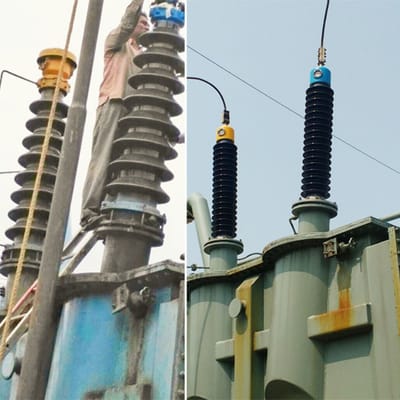
Transformer Bushing Parts
What Are Transformer Bushings?
Let us first review the definition of a transformer bushing before moving on to the varieties. To put it simply, a transformer bushing is an insulator that prevents a short circuit by enabling an electrical conductor to pass through a grounded barrier—like a transformer tank—safely. Envision it as a conduit that securely directs the wire through the transformer casing.
Types of Transformer Bushings
There are several varieties of transformer bushings, each intended for a particular use and set of operating parameters. Below is a summary of the most prevalent ones:
Porcelain Bushings
- Composite Bushings
- Oil-Impregnated Paper (OIP) Bushings
- Resin-Impregnated Paper (RIP) Bushings
- Gas-Insulated Bushings
1. Porcelain Bushings
After all this time, porcelain bushings are the transformer bushing equivalent of the grandfathers. Because of the high-strength porcelain used in their construction, they offer superior mechanical strength and insulation. There are several high-voltage applications for these bushings.
Pros:
- High mechanical strength
- Excellent thermal performance
- Long service life
- Cons:
- Heavy and brittle
- Prone to cracking under mechanical stress
2. Composite Bushings
The contemporary equivalent of porcelain bushings are composite bushings. They are composed of a weather-resistant silicone rubber or polymer housing that is placed atop an interior insulating core composed of fiberglass or resin. Because they are lighter and more durable, they are growing in popularity.
Pros:
- Lightweight and flexible
- High resistance to pollution and weather conditions
- Reduced risk of cracking
- Cons:
- Higher initial cost compared to porcelain
- Limited long-term performance data
3. Oil-Impregnated Paper (OIP) Bushings
In the realm of bushings, OIP bushings are comparable to radiators covered in oil. They have a mineral oil-impregnated paper core that serves as insulation. Excellent thermal conductivity and electrical insulation are provided by this combination.
Pros:
- Excellent electrical insulation
- High thermal conductivity
- Proven reliability over decades
- Cons:
- Requires regular maintenance to check for oil leaks
- Environmentally sensitive due to oil content
4. Resin-Impregnated Paper (RIP) Bushings
The less harmful alternative to OIP bushings are called RIP bushings. The paper insulation is impregnated with epoxy resin, which hardens to create a solid, durable insulator, in place of oil.
Pros:
- Environmentally friendly (no oil)
- Low maintenance
- High resistance to partial discharges
- Cons:
- Higher cost than OIP bushings
- Limited flexibility in some applications
5. Gas-Insulated Bushings
The high-tech member of the bushing family is the gas-insulated bushing. They employ sulfur hexafluoride, or SF6, gas inside a sturdy, sealed container as an insulating medium. They are employed in high-voltage situations where conventional bushings might not be appropriate.
Pros:
- Excellent insulation properties
- Compact and lightweight design
- High reliability and low maintenance
- Cons:
- High initial cost
- SF6 gas has a high global warming potential if leaked
Choosing the Right Bushing
A number of considerations must be balanced while choosing the correct transformer bushing, such as the voltage level, the surrounding environment, mechanical stresses, and financial limitations. For example, composite bushings perform better in polluted settings, even if porcelain bushings are sturdy and reasonably priced. While OIP bushings are a tried-and-true option, RIP bushings offer a more environmentally friendly option. Even though they are more costly, gas-insulated bushings are the best choice for the most demanding high-voltage applications.
Despite appearing to be a minor component of the entire transformer system, transformer bushings are essential to its dependable and effective functioning. Making informed judgments for different electrical applications can be aided by having a thorough understanding of the various types of bushings and their unique benefits and drawbacks. Every type of electrical power distribution component has a specific application, be it the conventional porcelain, the adaptable composite, the vintage OIP, the environmentally beneficial RIP, or the cutting-edge gas-insulated bushing. Get more information at transformer bushing types
